


Storykeepers: Celebrating Black Artists Beyond February
February lets us slow down.
Black History Month gives us words. Visibility. Reflection. It calls us to remember, to recognize, to see. It offers a pause—an invitation to look closely at stories that have shaped culture, community, and collective memory.
But it also reveals something quieter and more complicated: the limitation of celebrating Black artists only once a year.
Black Artists Are Storykeepers
When Black art is given space for just a single month, visibility can begin to stand in for validation. Celebration risks becoming seasonal. The work is acknowledged, then quietly set aside, as if its relevance has an expiration date. What gets lost in that rhythm is the understanding that Black art is not a moment—it is a living practice.
Black artists are not only historians of the past.
They are storykeepers—guardians of memory, imagination, interior life, and future worlds all at once.
What Storytelling Looks Like
Storykeeping is not always loud. It does not always arrive as protest or commentary. Often, it exists in quieter forms: in pattern, in repetition, in color, in gaze. In the ways visual language carries meaning when words are insufficient or unnecessary. In images that hold more than they explain.
There are Black artists who build layered, collage-like worlds around their figures—spaces where bodies are wrapped, framed, and held by texture and rhythm. These works feel expansive rather than fixed. They do not ask to be decoded quickly. They invite return. They allow meaning to unfold slowly, honoring the idea that stories are not linear—they are cumulative.
Black History Celebrates Joy and The Story of How Life Continues
Storykeeping also appears in works that center joy, softness, and everyday presence. This is an important reminder: Black history is not only documented through struggle or resistance. It is equally preserved through laughter, curiosity, imagination, and care. Through moments of ease. Through children at rest, at play, at peace.
Because the story is not always about what happened.
It is about how life continues.
BeatriCE Lebreton: One of Our Storykeepers
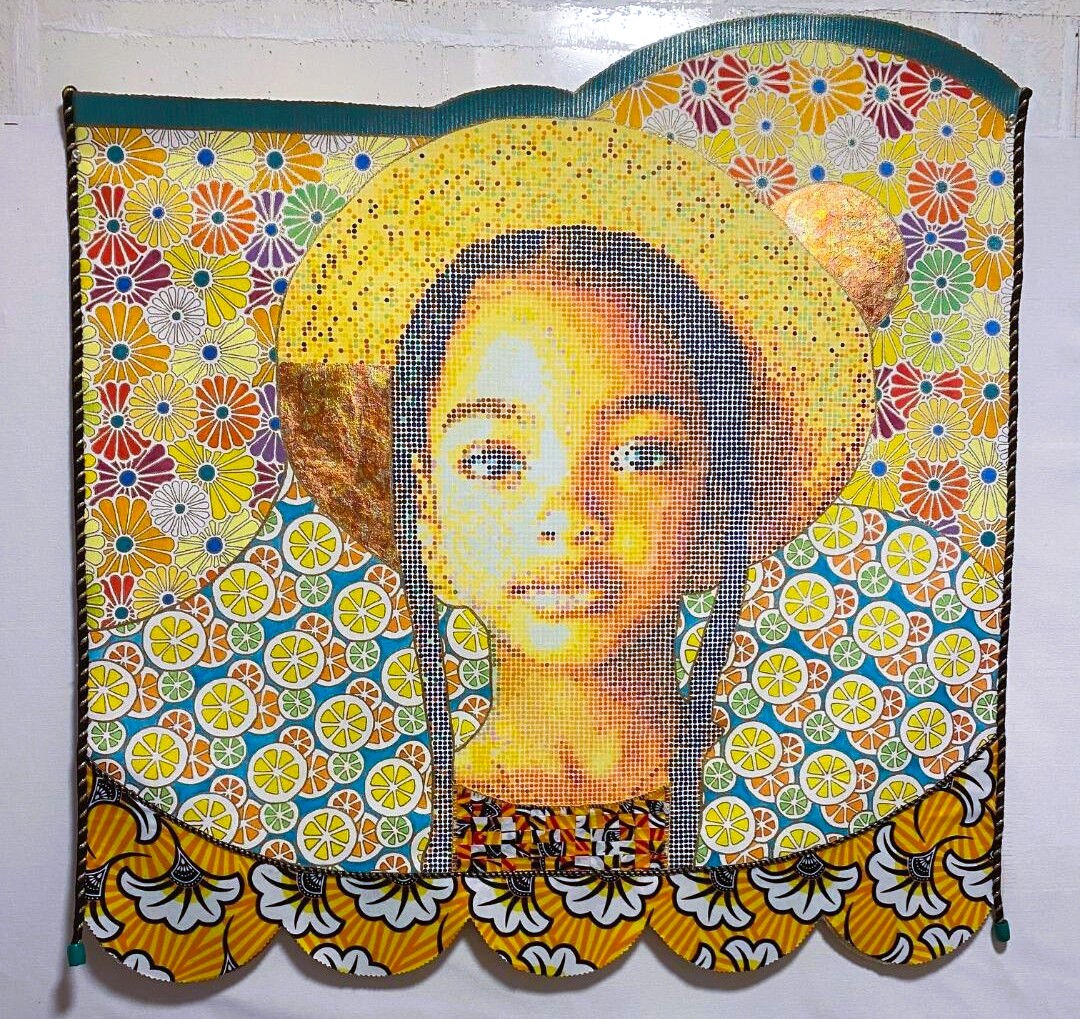
And sometimes, storykeeping looks like quiet guardianship.
In Sweet and Tangy, artist Beatrice Lebreton presents a child not as a symbol to be interpreted, but as a presence to be honored. The figure meets us with openness and calm, surrounded by color, pattern, and warmth. The work feels protective without being heavy. Celebratory without being loud.
The layered patterns that frame the child do not confine her—they create a sense of belonging. A visual embrace. The glowing, halo-like shape behind her head does not elevate her into spectacle; it asks us to look gently, to look longer. To recognize joy as something worthy of preservation.
This is not a narrative of burden.
It is a narrative of continuity.
The child in Sweet and Tangy does not perform history. She does not carry the weight of explanation. She simply exists—confident, present, whole. And in that presence, she holds story. Not as inheritance to be endured, but as something alive, bright, and ongoing.
This is storykeeping as care.
Storykeeping as joy.
Storykeeping as future.
Celebrate Black Art Beyond a One-Month Season
When Black art is only lifted up once a year, we lose this nuance. We lose the slow, sustaining work of preservation. We miss the way these pieces function not as reactions, but as containers—holding what has been lived, what is being lived, and what is still unfolding.
Black art does not fit into a one-month season.
It is not a classification.
It is not reactive.
It is constant.
To truly engage with the work of Black artists requires time. It asks us to live with the work. To allow it to occupy space in our homes, our offices, our daily routines. To let it speak quietly, repeatedly, without demanding immediate understanding.
That kind of looking is intentional.
And intention is where storykeeping thrives.
This is the work Framed Gallery is here for. Art that does not wait for February to matter. Art that carries stories forward gently, faithfully, and without urgency. Work that reminds us that preservation does not always look like memorial—it often looks like care.
Happy Black History Month.
And happy month after Black History Month.